 Second ReadWe check the psychology firstSecond ReadWe check the psychology first
Stop walking out with "let's revisit." Your boss usually has to sell your raise to someone you'll never meet. This playbook shows you how to read them, pick the week, name a number with a source and answer every dodge, so they walk upstairs with a case instead of a vague good feeling.
First edition, checked November 4, 2026. Instant 70-page PDF. Secure Stripe checkout. All sales are final.
You've read the raise advice. "Know your worth." "Power pose before you go in." "Ask in the morning, before decision fatigue." Somebody in the comments always says it best: "This is FAR too simplistic."
Here's what most of it skips. In most companies, your boss recommends and somebody else approves. A director trims the pot. HR checks the band. So when you ask, the real question isn't whether your boss likes you. It's whether they can win an argument about you, in a meeting you'll never see, against other managers fighting for their own people.
If they walk in with "she's great, really solid", your raise loses to a spreadsheet. If they walk in with one page, a number with a public source and a reason it has to be this quarter, they've got something to argue with.
That's the whole book in one line: hand your boss a case they can carry upstairs. And because a tactic is only as good as the study behind it, every move in it is graded. Including the famous ones that didn't hold up.

Most people walk in with a list of tasks. Their boss can't repeat a task list to a director. So before you write anything, find the two things your boss gets asked about most, and rewrite every task as a figure on one of those two lines.
This is one of six moves. The book does the same for timing, the number, the one-page Brief, the meeting and the follow-up, with three worked cases from first read to final email.
Six neutral questions that tell you who approves pay where you work, your band and the month to ask by. One page, with space for the answers.
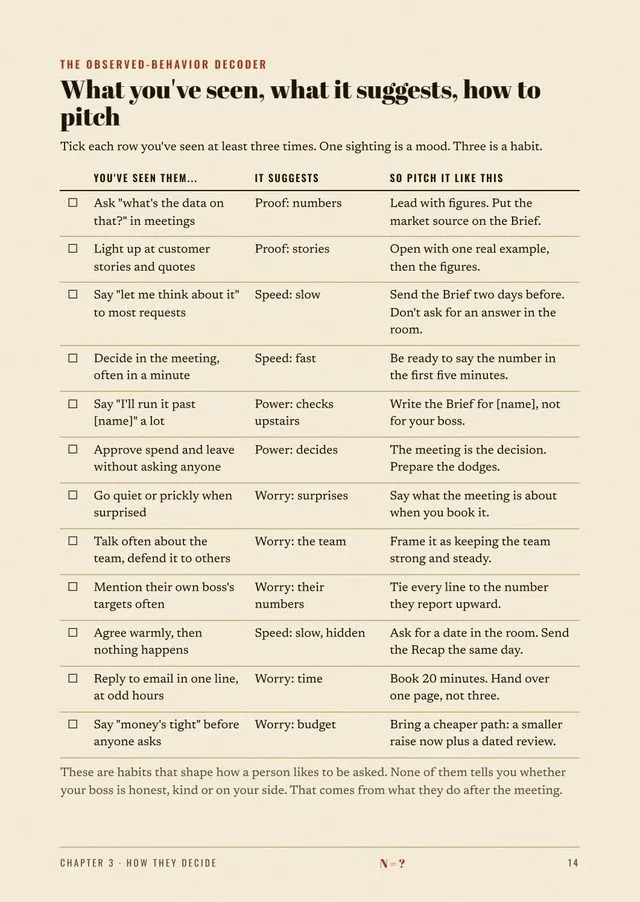
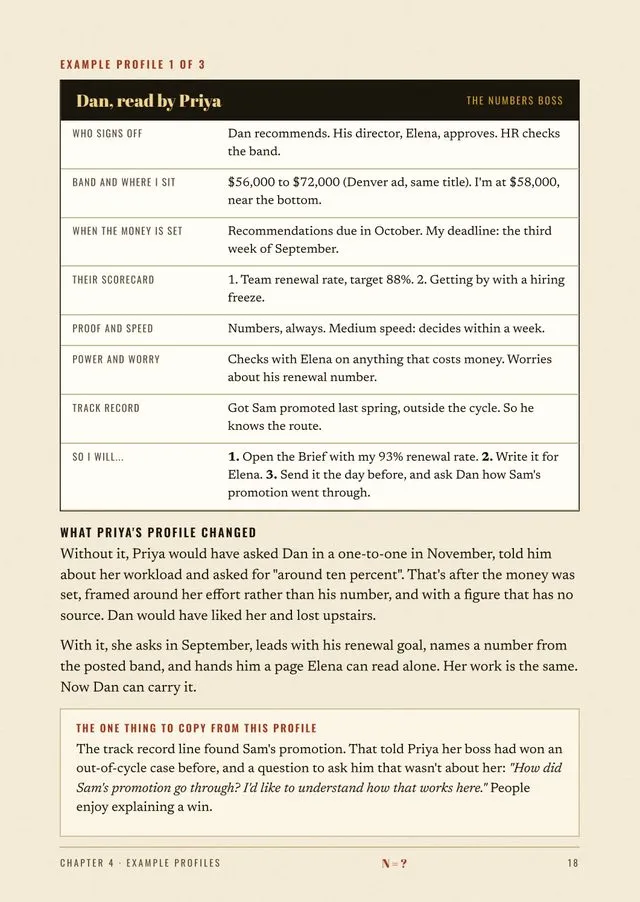
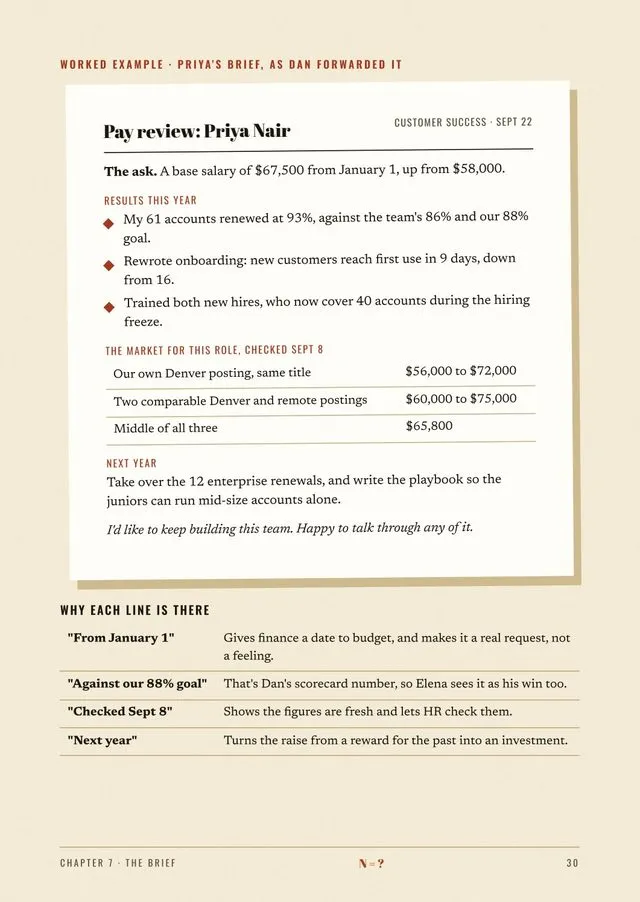
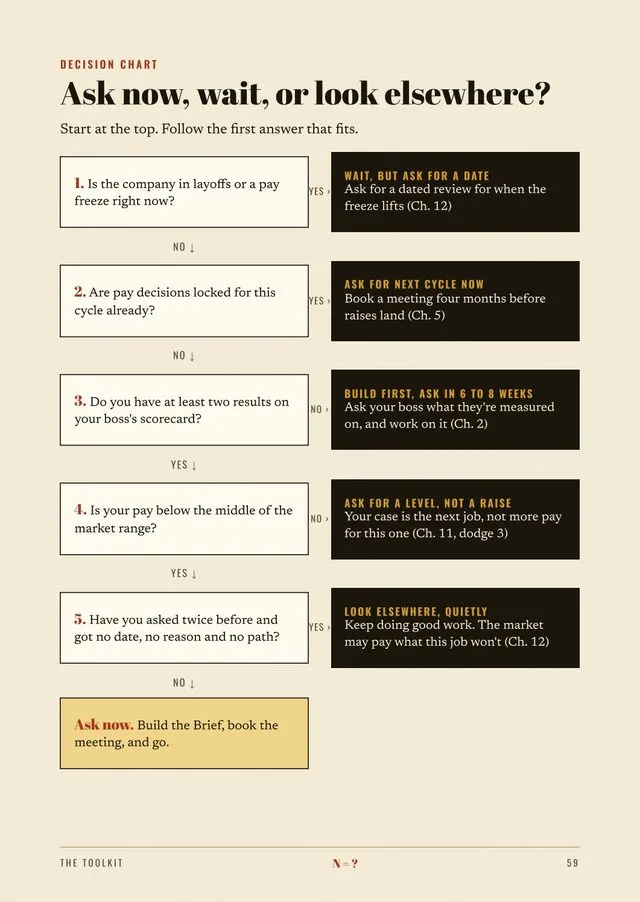
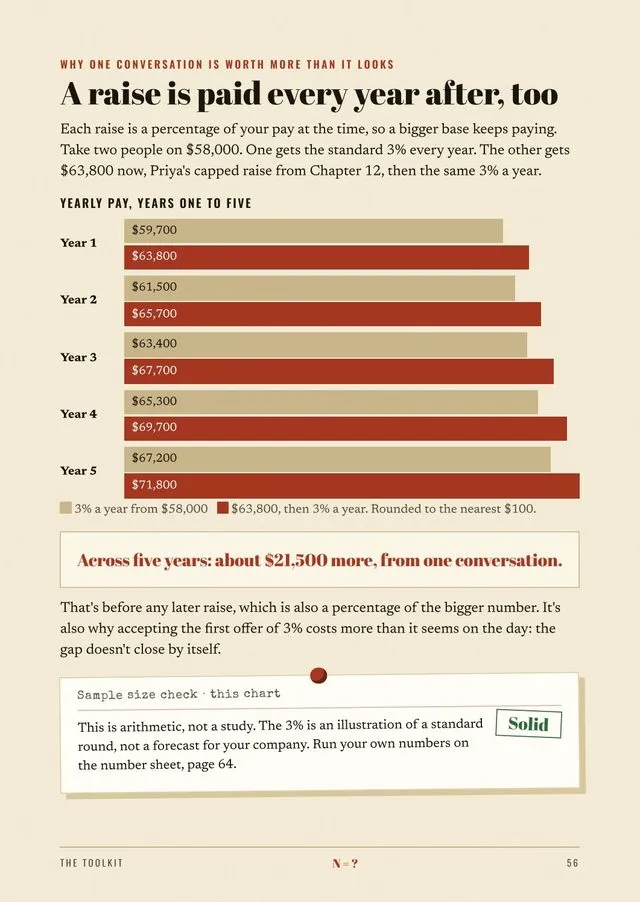
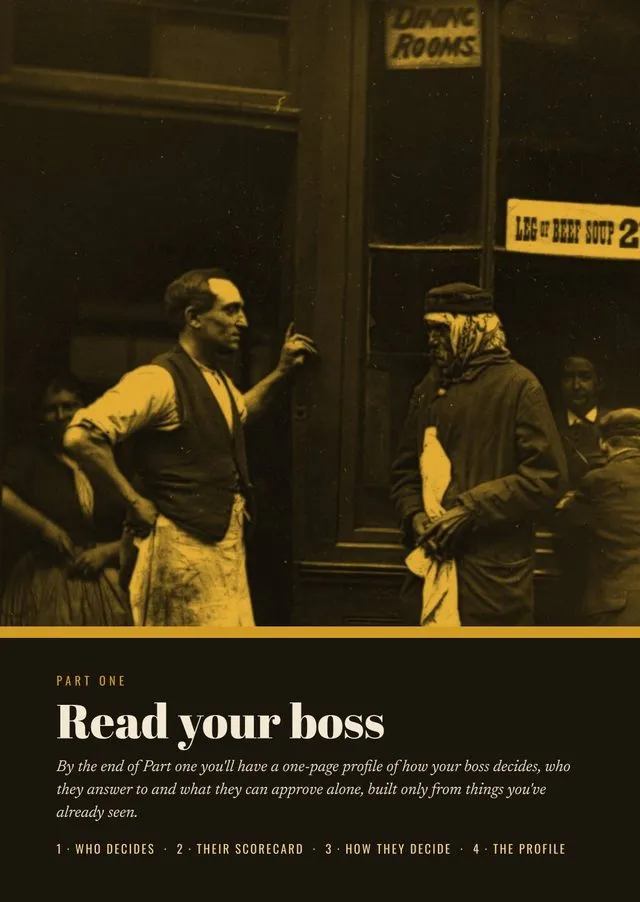
Instant 70-page PDF. Secure Stripe checkout. All sales are final.
Every tactic gets a grade: Solid, Shaky, Untested or Doesn't hold. Here are three you've probably been told to try, and what happened when other researchers checked.
A replication with 200 people found no hormone or behaviour effect, and the original study's first author said in 2016 she no longer believes it.
The parole-board study behind it had a case-order problem, and the idea underneath failed a 23-lab replication with over 2,000 people.
Across 206 studies, people spotted lies 54% of the time. The book reads your boss's habits over months instead.

I run Second Read, a channel that checks the psychology before it teaches it. When someone tells me a tactic works, I want to see the study: how many people, and did anybody try it again? A lot of confident tips fall apart at the second question.
This playbook is built on a plain fact about how pay moves inside a company, and it gives you the paperwork and the words for it. Then each tactic carries a card saying how good the evidence is, so you can decide what to spend your nerve on.
Everything in it is something you can say to your boss's face. If a tactic only works when they don't notice it, it isn't in here.
The book doesn't need your boss to like you more. It needs them to carry a case, and the easiest way to get a reluctant person to carry something is to make it light: one page, the numbers done, "why now" already written. Chapter 3 has a table for new, leaving, absent and defensive bosses. If asking brings threats or sudden bad reviews, the troubleshooting pages say to stop and document it instead.
Yes. One of the three worked cases is an hourly warehouse shift lead, and there's a section for jobs on a fixed grid, like government, teaching and union roles, where the question becomes "am I on the right step or grade?" rather than "can I have more?"
No. Nothing in the book depends on your boss not noticing. It's research on what your job pays, a clear summary of what you've done, good timing and calm answers to the usual replies. The few lab-tested moves, like pausing after you name a number, are graded honestly so you know how much weight they carry.
No, and be wary of anyone who does. Some companies can't pay, and some won't. The book gives you the read, the words and the paperwork, and a plan for a "no" that ends with a date in writing instead of nothing.
No. The start of the book has a short route for that: the number, the opening, the dodges and the one-page cheat sheet. You can read those in an evening.
You'll get the 70-page PDF to download straight after paying. It opens on phones, tablets and computers, and the cheat sheet and fill-in pages print cleanly.
All sales are final. This is a digital download you get right away, so we don't offer refunds. This doesn't affect any rights you have by law. That's why the contents, real inside pages and a free lesson are on this page, so you can check it first.
Instant 70-page PDF. Secure Stripe checkout. All sales are final.

The full kit
Both playbooks, the Raise Scripts and the Text Game in one kit, for the raise and the relationship, plus a one-page cheat sheet of every move.
$47See the kit

What actually makes someone want you and stay, from the first message to the commitment talk, built on attraction research and nothing made up.
$27See it
Seven moves backed by real research that make people more likely to say yes, with the exact words to use at work, on a date and at home.
FreeGet it free